Zetta Power
Power is a primary care about in modern semiconductor applications.
Zettabolt is addressing power concerns by providing innovative tools which help analyze and reduce power at all stages of the chip design flow.
WHY LOW POWER?
The Low Power Imperative
🔸 Unyielding demand for increased performance, connectivity, and intelligence across all major technology sectors.
🔸 Energy efficiency is no longer just desirable; it’s a critical requirement for product success and user experience.
AI/ML
- Massive compute
- Power-constrained Inference
5G/6G Communication
- Higher data rates
- Complex processing
Automotive
- ADAS, Infotainment
- Electrification (EVs)
IOT & Wearables
- Billions of devices
- Multi-year battery life
- Ultra-low power states
HPC & Data Center
- Exponential compute demand
- Energy cost
- Cooling limits
Mobile & Consumer
- Rich features
- Always-on demands
- Thermal constraint in thin form factors
WHY US
Zettabolt’s Intelligent Low Power Platform
Comprehensive Solution
- Will my chip fail due to physical power structure errors?
- Will my chip meet its power specification for signoff?
- What’s the estimated power impact of my RTL code?
- How can I maximize power savings at RTL?
- Can AI agents apply verified power savings to my RTL automatically?
Zettabolt’s Low Power Family
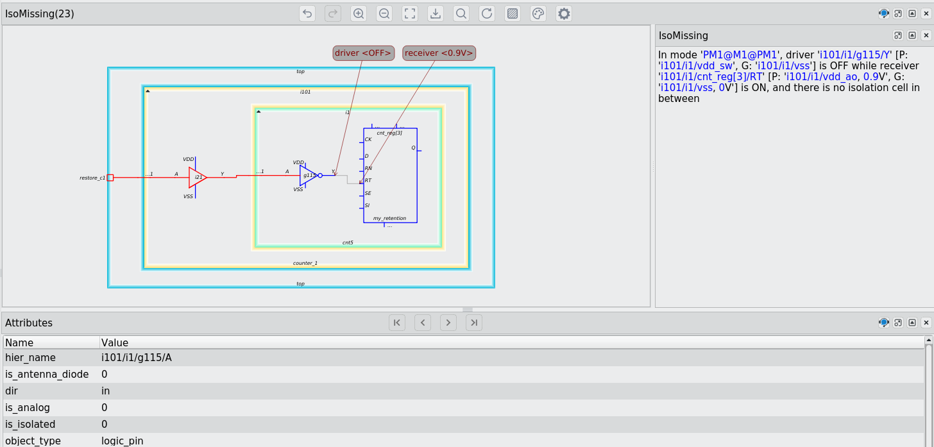
LOW Power Checker (LPC)

1. Library Checks
- Completeness of low power cells
- Correctness of low power cell definitions
- Conflicts with UPF definitions
2. Power Intent Checks
- Missing or redundant low power strategies
- Conflicts in UPF specifications
- Consistency of power states and strategies
3. Logic Netlist Checks
- Missing or redundant low power logic
- Correctness of control signal connection
- Conflicts between UPF and netlist
4. Physical Netlist Checks
- All checks in logic netlist checking
- Correctness of power and ground connections (including substrate)
- Correctness of power switch network
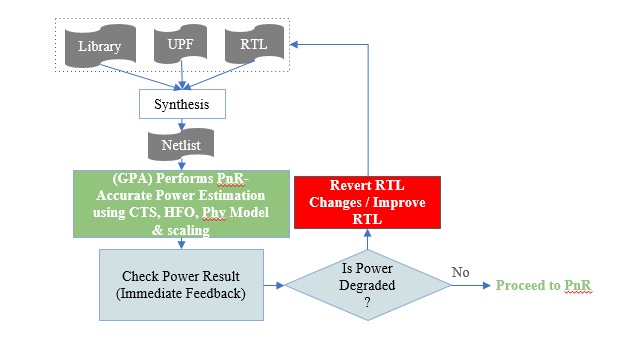
Gate Level Power Analyzer (GPA)
GPA provides the definitive gate-level power analysis and signoff capabilities required for today's most demanding System-on-Chip designs. It is engineered from the ground up to deliver uncompromising accuracy, industry-leading performance, and the capacity needed to ensure confident power closure and accelerate your time-to-market.

Within 2% of sign-off accuracy

Up to 4x faster than other tools

1B+ gate capacity

Support for
- 7nm libraries (with CCS)
- UPF
- SPEF, SDC, SDF
- SAIF / FSDB / VCD

Comprehensive Reports
- Average, Peak, Glitch
- Activity Plots
- Clock-gating efficiency
- Clock-tree

Rich GUI Support
- Design, Schematic viewer
- Power reports
- Activity & Peak-power plots
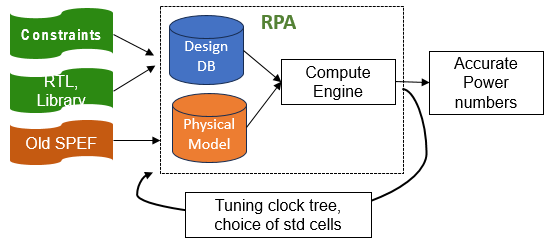
RTL Power Analyzer (RPA)
RPA delivers actionable, early-stage power insights directly at the RTL level, enabling proactive optimizations well before synthesis. Built to integrate seamlessly into your design flow, RPA empowers engineers to make informed, low-risk decisions that reduce overall power consumption.

Within 15% of sign-off accuracy with GPA
10X faster than other RTL synthesis based PA

1B+ gate capacity
RTL Power Explorer (RPE)
Our advanced RTL Power Exploration (RPE) tool engineered to maximize power savings by identifying and enabling sophisticated clock gating opportunities missed by conventional approaches. RPE dives deep into your design’s sequential behavior to unlock substantial, previously unapproachable power reductions.
Proprietary Deep Reachability Analysis Algorithm
Unique engine performs exhaustive reachability analysis across the flip flop and cone paths to enable clock gating on many logic levels and clock cycles, overcoming the limitations of standard heuristics.
Targeted Exploration & Guidance
Empowers designers by clearly highlighting specific, high-impact gating opportunities and providing actionable insights to guide the implementation of individual changes.
Other Features
• Advanced tools and suggestions for power saving
• Advanced clock trees and reset memory optimizations
• Visualize optimization opportunities

Agentic Power Exploration
Autonomous, RPE-assisted RTL power optimization: from months to hours. Zettabolt's Agentic Power Exploration pairs the RPE engine with AI agents that act as virtual designers. RPE finds and verifies the savings, and the agents apply them to your RTL.
The problem: power cleanup doesn't scale by hand
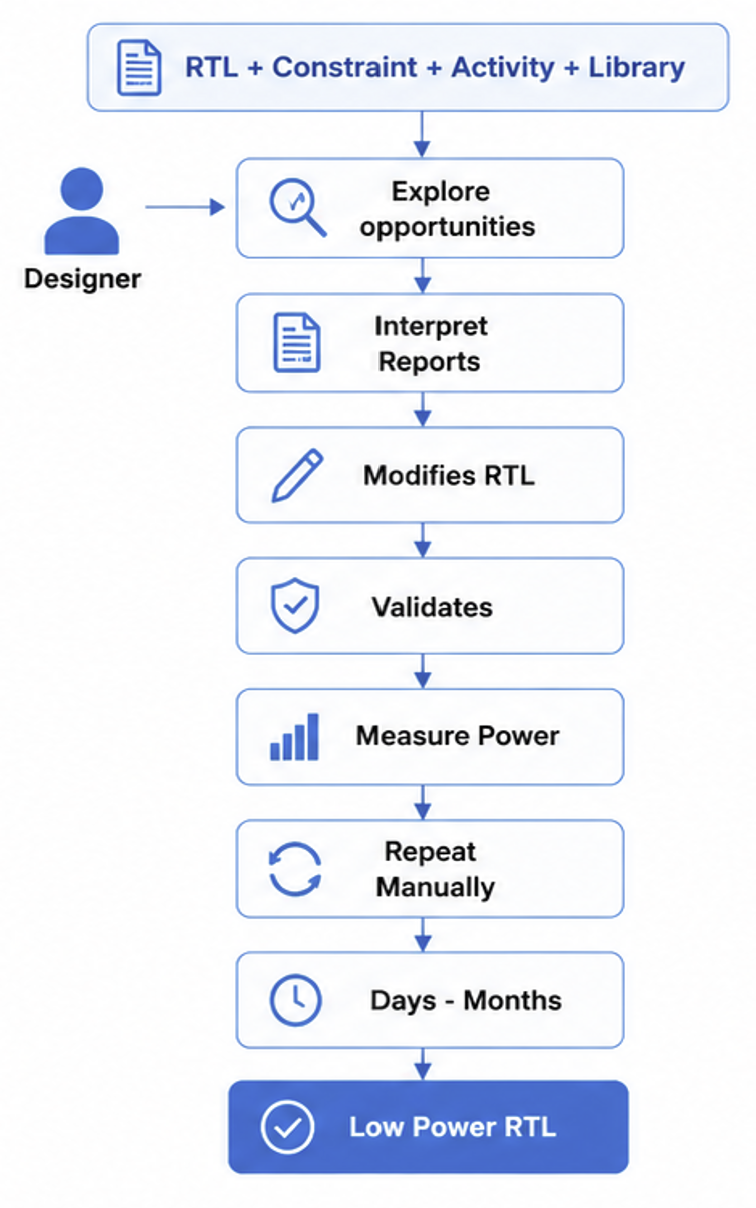
To optimize RTL power, designers load simulation data into a visualization tool, trace unnecessary toggling along data paths and manually pinpoint the registers and logic involved. Every change is manual, so the risk of functional errors is high, and the cycle repeats across the whole design. Power optimization can take months.
Optimizations using RPE
RPE scans the design, identifies key power-saving opportunities and generates detailed, actionable reports. It pre-verifies the suggested enable conditions, so designers can apply them with confidence. It is dramatically faster and safer than manual exploration, though applying a large set of recommendations by hand can still take days.
Why LLMs alone fall short
LLMs have broad knowledge but no built-in EDA engines to simulate, synthesize or measure. On their own they can't parse massive simulation data, project power savings accurately or guarantee functional correctness, and an unguided change can add bugs or even increase power.
Zettabolt Agentic Power Exploration: RPE + AI agents
RPE explores the design, identifies gating opportunities (clock, data, memory and sequential gating) and validates them to guarantee power savings. Using these pre-verified insights, AI agents make the RTL changes automatically. The fully automated workflow cuts optimization time, speeds up tape-out schedules and eliminates functional errors introduced by humans or LLMs.
Traditional flow
Agentic RPE flow
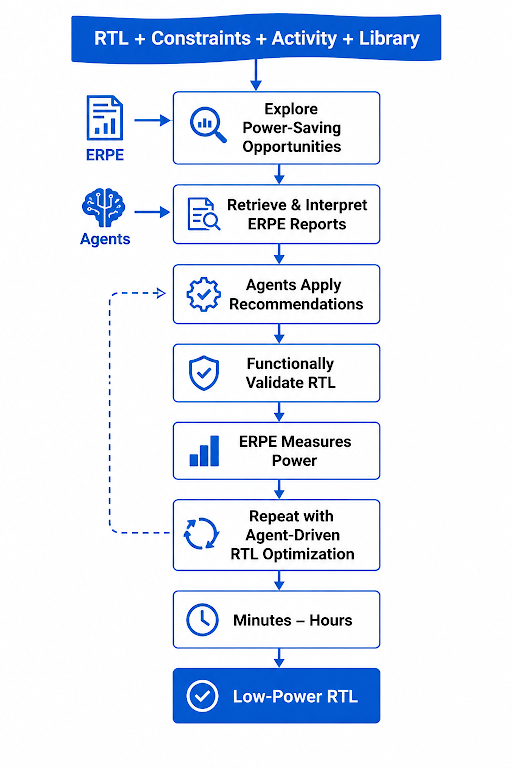
Four approaches, one clear winner
| Criteria | Traditional manual | RPE-assisted manual | LLM-only | Zettabolt Agentic |
|---|---|---|---|---|
| Time to close power | Weeks – months | Days | Hours (claimed) | Minutes – hours |
| Power savings verified? | No: trial & error | Yes, by RPE | No: unverified | Yes, by RPE, at every step |
| Functional risk | High | None | High | None |
| Designer effort | Very high | Medium | Low, but risky | Review only |
| Opportunity coverage | Limited by bandwidth | Full: RPE explores | Bounded by LLM knowledge | Full: explored & applied |
Why agentic wins
- RPE-verified at every step: no trial and error, no regressions
- Explores clock, memory, data and sequential gating across the full RTL
- Closed autonomous loop: explore → apply → validate → repeat
- Collapses months of manual effort into minutes or hours
- Removes the guesswork LLM-only flows can't resolve
- Engineers review outcomes; they don't hand-edit RTL
Ready to unlock the full potential of your enterprise knowledge?
OUR CUSTOMER CASE STUDIES